Laundry & Textiles Care: The Ultimate Guide to Washing, Stain Removal, and Maintaining Your Clothes
Proper laundry & textiles care decides whether your clothes last five seasons or five months. After ruining a cashmere sweater in one wash, shrinking three pairs of jeans beyond recognition, and permanently setting a red wine stain into white linen during the same year, I stopped trusting bottle instructions. I began running controlled tests across hundreds of loads instead. This guide shares what actually held up.
- Laundry & Textiles Care: The Ultimate Guide to Washing, Stain Removal, and Maintaining Your Clothes
- How to Read Laundry Care Labels Correctly
- Laundry & Textiles Care by Fabric Type
- Complete Stain Removal Guide
- Special Care for White Clothes, Delicates, Sportswear, and Dark Colors
- Drying and Ironing Best Practices
- Common Laundry Mistakes That Ruin Clothes
- Commercial Products vs Homemade Solutions
- Best Related Articles on Laundry & Textiles Care
- Frequently Asked Questions
- Your Clothes Are Worth the Extra Two Minutes
You will learn how to decode care labels in seconds, wash every common fiber without damage, tackle stains by both type and fabric, and stop the quiet accumulation of errors that destroy wardrobes. The core principle remains consistent: respect fiber structure, temperature limits, and mechanical stress.
How to Read Laundry Care Labels Correctly
Most people glance at symbols and guess. I once shrank a merino base layer to doll size because I assumed “wool” meant hand wash only. The label actually allowed machine wash on cold, gentle.
Care labels follow a fixed international sequence: washing, bleaching, drying, ironing, then dry cleaning. Once you learn that order, scanning takes three seconds.
Washing symbols (tub icon)
– Number inside = maximum Celsius temperature
– Hand in tub = hand wash only
– X through tub = do not wash
– One bar = gentle cycle
– Two bars = very gentle cycle
Drying symbols (square icon)
– Circle in square = tumble dry permitted
– Dots show heat level
– X through circle = no tumble drying
– Horizontal line = dry flat
– Vertical lines = drip dry
Ironing symbols (iron icon)
– One to three dots = low to high heat
– X through steam = no steam
The practical lesson stays simple: always check the first two symbols before loading the machine.
Laundry & Textiles Care by Fabric Type
Generic advice fails here. Silk and wool both count as delicate yet need opposite treatment. Here is the fabric-by-fabric approach I now use after repeated side-by-side tests.
Cotton
- Whites: 60 °C on normal cycle
- Colors: 40 °C maximum on normal or gentle
- Pre-wash before tailoring because cotton shrinks most in the first three washes
- Pre-soak heavily soiled items 20–30 minutes for better soil release
Linen
- Maximum 40 °C on gentle cycle with low spin
- Line dry or lay flat
- Iron while still slightly damp to avoid brittleness
Wool (Merino, Cashmere)
- Keep water at 30 °C or below
- Use wool cycle or hand wash with minimal spin
- Always dry flat
- Wash every 5–10 wears because wool resists odor naturally
- Over-washing remains the fastest way to degrade it
Silk
- Cold water only, 30 °C maximum
- Mild shampoo works as well as dedicated silk detergent
- Hand wash preferred; use a mesh bag on lowest machine setting when needed
- Roll in a towel to remove water instead of wringing
- Regular detergents often prove too alkaline and dull silk over time
Polyester and Synthetic Blends
- 30–40 °C on normal or gentle cycle
- High heat causes pilling and permanent distortion
- A microfiber-catching bag reduces microplastic shedding
Technical and Performance Fabrics
- Cold water exclusively
- Skip fabric softener entirely because it destroys moisture-wicking coatings
- Air dry only unless the label explicitly permits tumble drying
- Sports-specific detergents preserve DWR treatments far better than standard products
Complete Stain Removal Guide
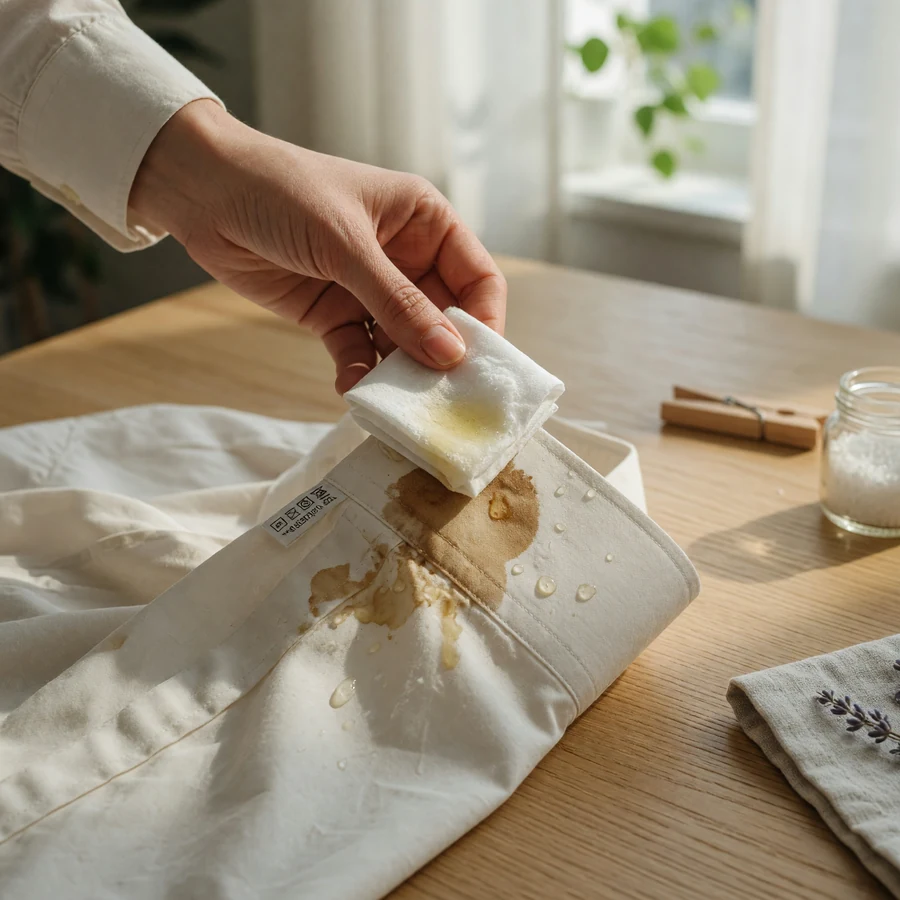
The non-negotiable rule is act fast and blot, never rub. After testing dozens of methods on fabric swatches, these protocols proved most reliable.
Protein stains (blood, egg, sweat, dairy)
– Use cold water only
– Rinse immediately
– Apply enzyme detergent or dish soap
– Let sit 10–15 minutes then wash
Oil and grease
– Absorb first with cornstarch or baking soda for 10 minutes
– Follow with dish soap worked gently into the fabric
Tannin stains (coffee, tea, red wine)
– Flush from the back with cold water
– Apply white vinegar
– Salt on red wine only buys time by absorbing liquid
Ink
– Isopropyl alcohol works best on ballpoint
– Blot, do not rub
– Permanent marker requires acetone on synthetics only after testing a hidden area
By fabric type
– White cotton tolerates oxygen bleach
– Colored cotton needs enzyme pre-treaters without chlorine
– Wool and silk must stay enzyme-free
– Synthetics require spot testing of solvents
Special Care for White Clothes, Delicates, Sportswear, and Dark Colors
- Whites should be washed separately
- Oxygen bleach in a 30-minute pre-soak restores dingy items more effectively than whitening detergents
- Delicates belong in mesh bags, washed inside out with minimal detergent
- Sportswear must be turned inside out
- Fabric softener destroys wicking properties after roughly eight washes
- Dark colors require cold water, inside-out washing, dark-specific detergent, and shade drying
Drying and Ironing Best Practices
Over-drying is the most common error I see. Remove items while still slightly damp to reduce wrinkles and fiber stress. Line-dry shirts from the hem, not the shoulders. Knitwear dries flat on towels.
Iron at the temperature shown on the label. Cotton and linen iron best when damp. Use a pressing cloth on silk. Iron dark fabrics inside out. For knits, iron lengthwise with the grain to avoid permanent distortion.
Common Laundry Mistakes That Ruin Clothes
These errors accumulate quietly:
- Using too much detergent leaves residue that attracts dirt
- Washing everything in hot water accelerates fiber damage for no gain on most loads
- Leaving wet clothes in the machine allows mildew within hours
- Overloading prevents proper agitation and stresses the machine
- Applying fabric softener to towels and performance fabrics reduces absorbency and wicking
- Ignoring zippers turns them into tiny abrasives on other garments
- Tumble drying everything degrades elastic and causes pilling
Commercial Products vs Homemade Solutions
Enzyme stain removers and oxygen bleach products deliver consistent results that homemade versions rarely match. Technical fabric detergents protect coatings no DIY mixture replicates.
White vinegar softens without residue and works well on towels. Baking soda controls odor effectively in sportswear. Dish soap handles grease as well as most pre-treaters. For everyday washing, however, a properly measured commercial detergent outperforms homemade alternatives.
Best Related Articles on Laundry & Textiles Care
These guides expand on specific areas in greater detail:
- How to Remove Specific Stains from Clothes
- How to Wash Wool Without Shrinking It
- How to Keep White Clothes White
- Sportswear Care: How to Wash Performance Fabrics
- How to Iron Clothes Properly
- Natural Laundry Products That Actually Work
Frequently Asked Questions
Can I wash all my clothes together in one load?
Technically possible, but color bleeding, mechanical damage from zippers, and temperature compromise make it a poor habit. Sorting by color and fabric type takes two minutes and extends garment life.
How much detergent should I actually use?
Less than the cap suggests. Modern HE machines need roughly half the recommended amount. Excess detergent stiffens fabric and can irritate skin.
Does washing in cold water actually clean clothes properly?
Modern detergents clean effectively at 30 °C for everyday soil. Hot water remains necessary for heavily soiled items, towels, and bedding.
Why do my dark clothes fade so quickly?
Warm water, optical brighteners, tumble drying, and direct sunlight are the usual culprits. Cold water, inside-out washing, dark-specific detergent, and shade drying slow the process dramatically.
Is fabric softener actually good for clothes?
Only on certain fabrics. It reduces absorbency in towels and destroys wicking in sportswear. Use it selectively.
How do I get rid of that musty smell in clothes that have been in the machine too long?
Rewash with a cup of white vinegar in the drum. Transfer laundry within two hours of cycle end to prevent recurrence.
Can I use the same stain remover on all fabrics?
No. Enzyme cleaners damage wool and silk because those fibers are protein-based. Always test solvents on a hidden seam.
How often should I wash clothes that do not look dirty?
T-shirts and underwear after every wear. Jeans every 3–5 wears. Sweaters every 3–5 wears. Wool every 5–10 wears. Outerwear every 10–15 wears or seasonally.
Your Clothes Are Worth the Extra Two Minutes
Most laundry damage builds gradually rather than dramatically. A slightly too-hot wash here, fabric softener on every load there, and garments degrade faster than necessary. The fixes remain small: read the label, sort properly, favor cold water, skip softener on performance pieces, and treat stains immediately. Start with whichever section matches your immediate problem. Your wardrobe will last longer and look better as a result.